

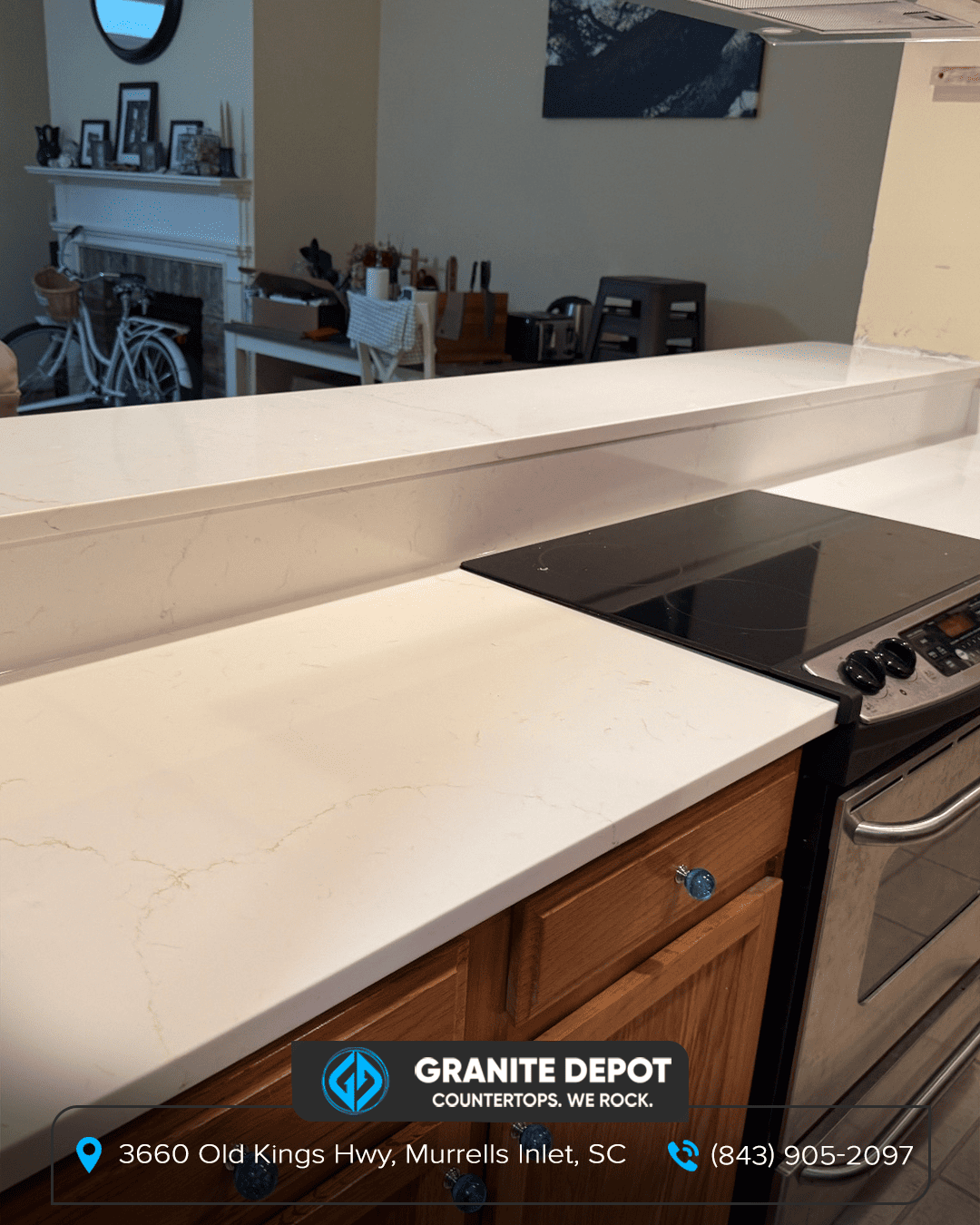
Choosing the right material for your countertops is one of the most important decisions you’ll make when renovating your kitchen or bathroom. In Aynor, SC, homeowners are often torn between two of the most popular options on the market: granite and quartz. Each material brings a unique set of advantages, along with a few trade-offs. Understanding these differences is key to selecting a surface that fits your lifestyle, aesthetic goals, and long-term investment strategy.
With the help of experienced granite companies in Aynor, SC, like Granite Depot of Myrtle Beach, making that choice becomes easier. In this article, we’ll take a closer look at how granite and quartz compare in terms of durability, design, maintenance, cost, and environmental impact — so you can decide which surface is truly right for your home.

Natural vs. Engineered: What’s the Real Difference?
The first and most fundamental difference between granite and quartz is how they’re made. Granite is a natural stone that’s quarried from the earth in large slabs. After being cut and polished, it’s installed in your home, retaining all the unique veining, coloration, and textures that only nature can create. No two granite countertops are exactly alike, which is why many homeowners choose granite for its one-of-a-kind look.
Quartz, on the other hand, is engineered. It’s made by combining around 90–93% natural quartz crystals with resins, polymers, and pigments. The result is a non-porous, durable, and consistent material that can be manufactured in nearly any color or pattern imaginable. This engineered consistency appeals to many modern homeowners who want uniform tones or prefer countertops that mimic the look of marble or concrete.
Granite companies in Aynor, SC often offer both options in their showrooms — allowing you to compare these differences in person. While granite celebrates natural variety, quartz offers control, consistency, and custom color palettes.
Maintenance and Longevity: Which Material Works Harder?
When it comes to maintenance, quartz has a clear advantage. Because it’s non-porous, it doesn’t require sealing, and it resists staining from spills like wine, coffee, or cooking oils. Daily cleaning requires only a soft cloth and a mild detergent. Its dense surface also makes it highly resistant to bacteria and mold, making quartz a hygienic choice for families.
Granite is naturally porous, which means it does require sealing upon installation — and then resealing every 1–2 years, depending on use. That said, many homeowners still choose granite because, with the right care, it lasts a lifetime. Plus, granite holds up extremely well under heat — you can place hot pots and pans directly on the surface without worry. While quartz is also heat-resistant, it’s more sensitive to extreme temperatures, especially around seams or edges, and requires a hot pad or trivet to protect it.
Several granite companies in Aynor, SC provide sealing services and maintenance recommendations, helping homeowners keep their granite countertops in top condition for decades. Both materials are highly durable, but the maintenance style that suits your lifestyle could be the deciding factor.
Design Flexibility and Visual Appeal
One of the biggest benefits of quartz is its design flexibility. Because it’s manufactured, you can get quartz in nearly any color — from pure white to jet black — and in patterns that resemble natural stone, concrete, or even fabric textures. For homeowners looking to match a specific cabinet color, backsplash tile, or modern color scheme, quartz often provides a perfect solution.
Granite, meanwhile, offers a timeless beauty that appeals to those who want a more organic, earthy feel. Each slab of granite has its own unique movement and veining, which adds depth and visual interest. While quartz may offer uniformity, granite’s natural imperfections are often considered part of its charm.
The top granite companies in Aynor, SC often invite clients to hand-pick their granite slabs — a process that allows you to see exactly what your countertop will look like. This personal selection process is especially important when choosing granite with dramatic veining or color shifts.
Whether you’re designing a classic, elegant kitchen or a contemporary bathroom, both granite and quartz can elevate the space. It comes down to whether you prefer the character of natural stone or the refined consistency of engineered quartz.

Cost, Value, and Resale Considerations
In terms of initial cost, granite and quartz are surprisingly competitive. Depending on the color, thickness, edge style, and supplier, both materials can range from mid- to high-end pricing. Exotic granite varieties or custom quartz finishes can push prices higher, but in general, the gap between the two is closing as quartz becomes more widely available.
From a long-term investment perspective, both materials hold their value well — especially when installed professionally. Countertops are a major focal point in any kitchen or bathroom, and potential buyers often view granite or quartz as desirable features.
Many granite companies in Aynor, SC offer installation packages that include design consultation, templating, fabrication, and professional installation — all of which contribute to long-term durability and increase property value. Choosing a reputable supplier is key to ensuring your investment pays off in both function and aesthetics.
Environmental Impact and Sustainability
As more homeowners focus on sustainable living, it’s worth considering the environmental impact of your countertop choice. Granite, being a natural material, must be extracted through quarrying. While this is a resource-intensive process, granite is a long-lasting product that requires little in the way of chemical treatments. And since it can last for decades without replacement, its environmental footprint is spread out over many years.
Quartz, while made from abundant natural crystals, is engineered using resins and sometimes imported across long distances. However, many manufacturers now use recycled materials and low-emission production methods, making quartz a more eco-conscious choice than it was a decade ago.
Leading granite companies in Aynor, SC often carry certifications and supplier information that can help you choose responsibly sourced materials. If sustainability is important to you, be sure to ask your fabricator about recycled content, local sourcing, and long-term impact.

Conclusion
The choice between granite and quartz ultimately depends on your lifestyle, design goals, and maintenance preferences. Granite offers unmatched natural beauty, durability under high heat, and a rich, organic texture that adds depth to any room. Quartz delivers low-maintenance convenience, uniform design options, and impressive resistance to stains and bacteria — ideal for busy households.
For homeowners in Aynor, SC, the best way to make the right choice is to consult with experienced professionals who understand both materials. Granite companies in Aynor, SC, including Granite Depot of Myrtle Beach, offer a wide variety of stone options, expert design guidance, and seamless installation services that take the guesswork out of your renovation.
Whether you’re drawn to the elegance of granite or the practicality of quartz, the right material — and the right team — will ensure your new countertops are as functional as they are beautiful. Don’t rush the decision; explore samples, compare finishes, and rely on trusted granite companies in Aynor, SC to help you make a choice you’ll love for years to come.