


For a small kitchen, we usually recommend choosing a countertop pattern that supports the room rather than competing with it. Large-scale veining, strong movement, and very busy patterns can make a compact space feel visually crowded, while subtle movement and carefully positioned patterns can make the same kitchen feel more open.
When we help homeowners searching for granite countertops in Bucksport, SC, we look at more than the slab itself. Cabinet color, backsplash, flooring, lighting, appliance placement, and the amount of natural light all affect how a countertop pattern will appear once installed.
At Granite Depot of Myrtle Beach, we also ask how the kitchen will actually be used. A countertop that looks impressive in a large showroom may behave very differently when it is installed across a small L-shaped kitchen with several seams and cutouts.
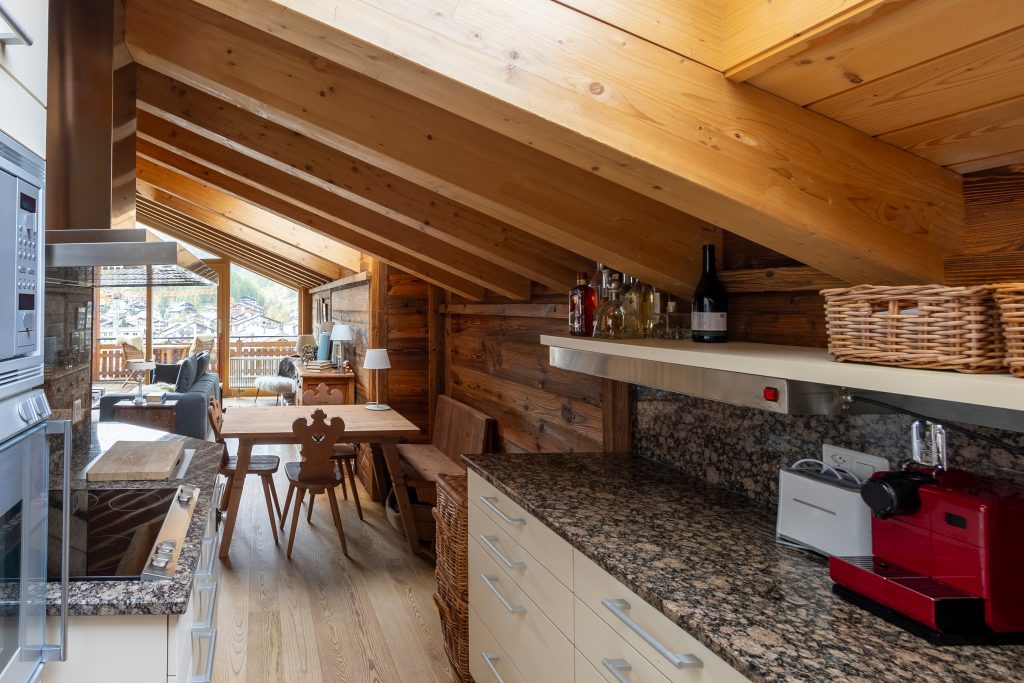
What countertop pattern works best in a small kitchen?
A countertop with moderate movement and a relatively consistent background usually works best in a small kitchen. This gives the surface enough visual interest without making every part of the room compete for attention.
That does not mean homeowners have to choose a plain white countertop. Subtle veining, soft mineral movement, and natural variations can add character while maintaining a sense of continuity.
We often suggest looking at the full slab rather than relying on a small sample. A pattern that appears delicate on a 4-inch sample can become much more prominent when it covers an entire countertop.
Should you choose large or small-scale veining?
For most small kitchens, we recommend moderate or smaller-scale veining, especially when the cabinets or backsplash already contain noticeable detail. Large, dramatic veins can work, but they need more planning because the pattern becomes a major part of the room.
When we evaluate granite countertops in Bucksport, SC, we consider where the strongest areas of the slab will land. A large vein crossing a sink, cooktop, or seam can look completely different from the same vein running through an uninterrupted section of countertop.
This is why slab layout matters. We can sometimes rotate or position a slab so the most distinctive part of the pattern appears where it has the most visual impact.
Is a consistent countertop pattern better for a small kitchen?
Usually, yes, because visual consistency can make a compact kitchen feel less fragmented. A relatively uniform surface allows the cabinets, hardware, backsplash, and other features to provide the contrast.
This can be especially useful in kitchens with several countertop sections. An L-shaped layout already creates visual breaks, so a calmer pattern can help those sections read as one continuous surface.
However, we do not recommend choosing a countertop simply because it is uniform. We still consider the cabinet color, lighting, and homeowner’s preferred style before making a recommendation.
Which materials offer good pattern choices?
Granite, quartz, marble, and quartzite can all work in a small kitchen, but their patterns behave differently. Granite often has natural mineral movement, quartz can provide controlled veining, marble can have strong linear patterns, and quartzite can range from subtle to highly dramatic.
| Material | Typical pattern characteristics | Small-kitchen consideration |
|---|---|---|
| Granite | Mineral movement and natural variation | Review the full slab for pattern scale |
| Quartz | Controlled veining and consistent backgrounds | Often easier to coordinate |
| Marble | Veins can be prominent and directional | Strong patterns need careful layout |
| Quartzite | Can range from subtle to dramatic | Full-slab viewing is important |
When homeowners compare granite countertops in Bucksport, SC, we encourage them to look at several slabs within the same material category. Two slabs labeled with the same stone type can have noticeably different movement and color distribution.
Should the countertop match the cabinets?
No, but the colors should work together. We usually recommend creating enough contrast for the countertop to remain visible without creating an abrupt transition.
For example, light cabinets can work with a soft gray or warm-veined countertop, while darker cabinets may benefit from a lighter surface that adds visual separation. The countertop does not need to repeat the cabinet color exactly.
In a small kitchen, we also consider the backsplash. If both the countertop and backsplash have strong patterns, the room can quickly become visually busy.
Should the backsplash be simple when the countertop has a pattern?
Yes, in many cases a simpler backsplash creates a better balance. When the countertop has significant veining or movement, we often recommend a backsplash with a quieter pattern so the two surfaces do not compete.
The opposite can also work. If the countertop is relatively consistent, we can use the backsplash to introduce more texture or pattern.
We prefer making this decision after seeing the actual countertop slab. A small sample does not always show how the veins, mineral movement, or color transitions will interact with the backsplash.

Does countertop color affect how large a kitchen feels?
Yes, lighter and more visually continuous surfaces can make a small kitchen feel more open, although lighting and cabinet color also play major roles. Dark countertops can still work beautifully when the surrounding design provides enough contrast and light.
We look at the room’s natural light before recommending a color. A countertop that appears bright in a well-lit showroom can look substantially darker in a kitchen with limited windows.
For homeowners considering granite countertops in Bucksport, SC, we suggest viewing samples near the cabinets and backsplash under both natural and artificial lighting.
How should you handle seams in a patterned countertop?
We recommend planning seams around the pattern rather than treating them as an afterthought. A seam cannot always disappear completely, but careful fabrication and slab placement can make it less visually distracting.
Seam location depends on the countertop shape, slab dimensions, sink and cooktop openings, cabinet layout, and the material itself. Pattern direction also matters because a seam through a highly contrasting vein can be more noticeable than one through a relatively consistent area.
At Granite Depot of Myrtle Beach, we review the layout before fabrication so we can identify where seams and cutouts will fall. This is especially important for small kitchens because every section of countertop is more visible.
What countertop prices should you expect?
Reference material pricing can help establish a starting budget, but the final installed price depends on fabrication, cutouts, edges, delivery, and installation. Our current reference prices are $42 per square foot for granite, $55 for quartz, $55 for marble, and $75 for quartzite.
| Material | Reference material price | Maintenance considerations | Pattern range |
|---|---|---|---|
| Granite | $42/sq. ft. | May require periodic sealing | Moderate to dramatic |
| Quartz | $55/sq. ft. | Low routine maintenance | Consistent to veined |
| Marble | $55/sq. ft. | More care; can etch | Subtle to dramatic |
| Quartzite | $75/sq. ft. | May require periodic sealing | Subtle to highly varied |
These are material reference prices rather than complete project quotes. Sink cutouts, cooktop openings, edge profiles, seams, delivery, installation, and backsplash work can all affect the final cost.
At Granite Depot of Myrtle Beach, we review the complete countertop specification rather than quoting only the square-foot material price.
How long does a patterned countertop take to fabricate?
A typical countertop project can take about 7-10 days from final templating through fabrication and installation, depending on scheduling, material availability, and project complexity. The process begins after the cabinets are installed and properly leveled.
We generally follow this sequence:
- Confirm the countertop material and slab.
- Install and level the cabinets.
- Complete the final countertop template.
- Plan seams, cutouts, and edge profiles.
- Approve the slab layout.
- Fabricate the countertop.
- Deliver and install the finished pieces.
- Coordinate related backsplash or finishing work.
Pattern planning is part of this process. We do not want to finalize the layout before knowing exactly where sinks, appliances, corners, and seams will occur.
Should you use the same countertop pattern throughout the kitchen?
Yes, usually, if the kitchen is small and contains several connected countertop sections. Keeping the same material and general pattern creates continuity and prevents the space from feeling visually divided.
That does not mean every section will look identical. Natural stone can vary across a slab, and even engineered materials may have repeating or directional patterns.
For a small kitchen, consistency is often more useful than trying to introduce multiple countertop designs. We would rather create one strong visual story than make the room feel like several separate areas.
What should you look for when choosing the slab?
We recommend evaluating the entire slab, not just its color name or small sample. Look for the scale of the pattern, direction of the veins, areas of strong contrast, and how those features will interact with cabinet doors and appliances.
We also check:
- Where the strongest veins will appear.
- Whether the pattern is directional.
- Where seams may be required.
- How sink and cooktop cutouts will affect the visual layout.
- Whether the countertop works with the backsplash.
- How the material looks under the kitchen’s lighting.
- Whether the maintenance requirements fit the household.
This approach is especially useful when comparing granite countertops in Bucksport, SC because natural granite can have significant variation from one slab to another.
FAQ: Choosing a Countertop Pattern for a Small Kitchen
Is a busy countertop bad for a small kitchen?
Not necessarily. A busy pattern can work when the cabinets and backsplash are relatively simple, but strong patterns require more careful slab and seam planning.
Is quartz a good choice for a small kitchen?
Yes. Quartz offers a wide range of consistent backgrounds and veining patterns and generally requires little routine maintenance.
Should small kitchens use light countertops?
Light countertops can help a small kitchen feel more open, but the best choice depends on lighting, cabinet color, flooring, and the overall design.
Does granite have to be plain for a small kitchen?
No. Granite can have beautiful movement in a small kitchen. We simply pay closer attention to pattern scale and where the strongest areas of the slab will be placed.
Can marble work in a small kitchen?
Yes, although marble requires more care because it can etch and stain more readily than some other countertop materials.
How much does granite cost?
The reference material price used here is $42 per square foot. The complete installed cost depends on the slab, fabrication, edge, cutouts, delivery, and installation.
How long does countertop installation take?
A typical project can take about 7-10 days from final templating through fabrication and installation, depending on material availability and project requirements.

Our Countertop Services in Myrtle Beach, SC
We work with homeowners in Myrtle Beach, SC and surrounding communities, including Bucksport, on countertop selection, fabrication, installation, sink and cooktop cutouts, edge profiles, seams, and backsplash coordination. At Granite Depot of Myrtle Beach, we help homeowners compare granite, quartz, marble, and quartzite based on pattern, maintenance, and everyday use.
For homeowners searching for granite countertops in Bucksport, SC, we recommend choosing the slab with the entire kitchen in mind. We can help evaluate the countertop alongside the cabinets, backsplash, lighting, seams, and layout so the final pattern feels appropriate for the size and function of the room.