

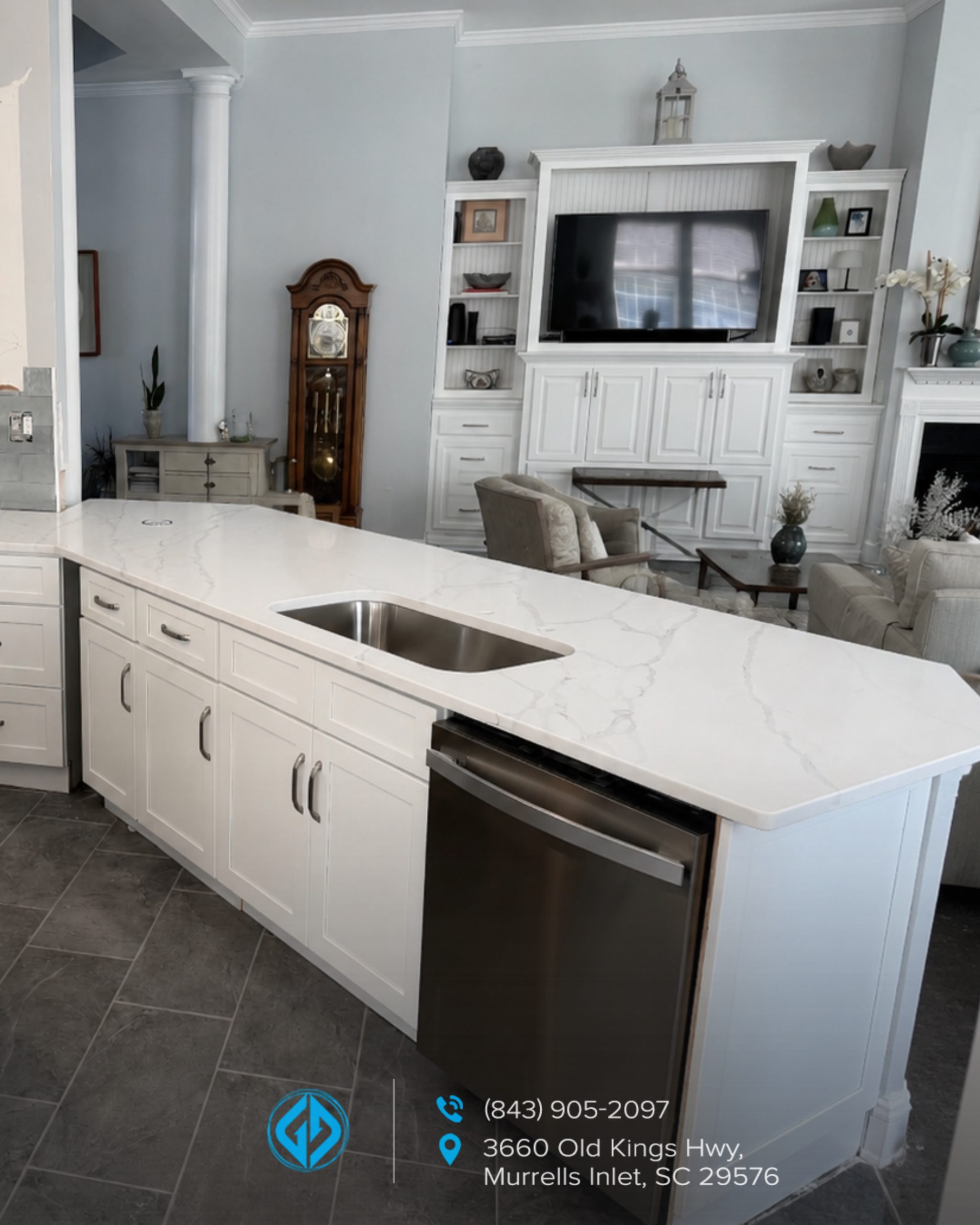
Quartz is usually the best countertop material for homes near the coast or in high humidity because it is nonporous, stain-resistant, and does not need sealing. Granite and quartzite can also work well when sealed properly, while marble needs more care in damp, busy kitchens and bathrooms.
At Granite Depot of Myrtle Beach, we help homeowners think beyond color when choosing countertops for coastal-area homes. Humidity, salt air, daily moisture, sandy hands, wet towels, and frequent cleaning all affect how a surface performs. For homeowners choosing quartz countertops in Red Hill, SC, the best material is usually the one that handles moisture without adding a complicated maintenance routine.

Why does humidity matter when choosing countertops?
Humidity matters because moisture stays in the air longer and can affect the full countertop area, not just the stone surface. Seams, caulk lines, backsplash edges, sink cutouts, cabinet contact points, and wall areas all need proper planning.
A countertop may look solid, but the kitchen or bathroom around it still deals with moisture. Coastal homes often see damp air, open windows, wet swimsuits, beach towels, and frequent wiping. A material that resists absorption makes daily life easier.
| Humidity Issue | Why It Matters |
|---|---|
| Damp air | Slows drying around sinks and backsplashes |
| Salt air | Increases cleaning needs near coastal areas |
| Frequent wiping | Surface should resist streaking and staining |
| Wet hands and towels | Creates repeated moisture exposure |
| Sink splash zones | Makes cutouts and caulk lines important |
| Poor ventilation | Keeps surfaces damp longer |
The best countertop for humidity is not only about the slab. It is also about fabrication and installation details.
Is quartz best for coastal homes?
Quartz is usually best for coastal homes when homeowners want low maintenance, strong stain resistance, and no sealing. It works well in kitchens, bathrooms, laundry rooms, wet bars, coffee stations, and vacation homes.
Quartz is nonporous, so it does not absorb water the way many natural stones can. That makes it practical near sinks, vanities, dishwashers, and drink areas. It also resists common household stains from coffee, tea, juice, soap, toothpaste, makeup, and cooking spills.
For quartz countertops in Red Hill, SC, we often recommend soft white, warm gray, beige, greige, or lightly veined quartz. These colors stay bright without showing every fingerprint, water spot, or bit of dust as quickly as very dark polished surfaces.
Is granite good in high humidity?
Granite is a strong choice in high humidity when it is sealed as needed. It is durable, heat-resistant, and naturally patterned, which helps hide small marks from daily use.
Granite is a natural stone, so porosity varies by slab. Some granite is very dense. Other granite needs more attention around sinks, wet bars, and bathroom vanities. Sealing helps protect the surface from staining and moisture absorption, but standing water should still be wiped up.
Granite is often a good choice for homeowners who want natural stone and do not mind basic maintenance. It can work especially well in busy kitchens, outdoor covered areas, and high-use family spaces.
Is marble a bad choice for humid homes?
Marble is not automatically a bad choice, but it is usually the highest-maintenance option in humid or coastal homes. It can stain, etch, and show water marks more easily than quartz or granite.
Marble reacts to acidic foods, drinks, and cleaners. Lemon juice, vinegar, wine, coffee, tomato sauce, and some bathroom products can leave dull spots or marks. Humidity does not ruin marble by itself, but damp daily-use areas make maintenance more important.
Marble can still be beautiful in powder rooms, careful-use bathrooms, baking areas, and decorative spaces. It is less practical for homeowners who want a countertop they do not have to think about.
Can quartzite handle coastal humidity?
Quartzite can handle coastal humidity well when the slab is suitable and sealed correctly. It is a hard natural stone with strong heat resistance and beautiful movement.
Quartzite is often chosen when homeowners want a premium natural look with more durability than marble. It can work in kitchens, bathrooms, bars, and statement islands. Like granite, it still needs sealing as needed because it is a natural stone.
The exact slab matters. Some quartzite surfaces are denser than others, so full-slab review and care instructions are important before approval.
How do quartz, granite, marble, and quartzite compare in humidity?
Quartz is usually the easiest material for high humidity because it does not need sealing. Granite and quartzite are strong natural stone choices when sealed, while marble needs the most careful use.
| Material | Moisture Resistance | Heat Resistance | Stain Resistance | Maintenance Level |
|---|---|---|---|---|
| Quartz | Very good | Moderate | Very good | Low |
| Granite | Good when sealed | High | Good when sealed | Moderate |
| Marble | Moderate | Good but sensitive | Moderate | Higher |
| Quartzite | Good when sealed | High | Good when sealed | Moderate |
Granite Depot of Myrtle Beach usually recommends quartz for homeowners who want the simplest care routine in humid areas. Granite or quartzite can make sense when natural stone character is the priority and sealing is acceptable.
What countertop works best for coastal kitchens?
Quartz usually works best for coastal kitchens that need low maintenance and moisture resistance. Granite works well for homeowners who cook heavily and want stronger heat resistance.
A coastal kitchen often has light cabinets, sandy tones, blue accents, warm wood, or soft gray finishes. Quartz can support that look without becoming too busy. Granite can add natural texture and movement, especially if the kitchen needs warmth.
For vacation homes or rental properties, quartz is often the easier choice because different people may clean and use the kitchen. For full-time homeowners who love natural stone, sealed granite or quartzite can still be practical.
What countertop works best for humid bathrooms?
Quartz usually works best for humid bathrooms because it handles water, toothpaste, soap, makeup, skincare products, and daily wiping without sealing. It is especially practical for shared bathrooms and primary vanities.
Granite can also work in bathrooms when sealed properly. Marble looks elegant but can show water marks, product stains, and etching more easily. Quartzite can be a strong natural option when the homeowner wants a more dramatic vanity surface.
Bathroom backsplashes matter in humid spaces. A 4-inch stone backsplash or full-height tile backsplash helps protect the wall behind sinks.
What colors hide water spots near the coast?
Medium tones, soft patterns, warm whites, greige, beige, and low-contrast veining usually hide water spots better than solid black or glossy pure white surfaces. Coastal homes often look best with colors that feel light but not sterile.
Very dark polished countertops can show dried water, salt residue, fingerprints, and dust. Pure white glossy surfaces can show coffee, crumbs, makeup, and streaks. A subtle pattern gives the surface more forgiveness between cleanings.
Good coastal countertop directions include:
- Warm white quartz with soft veining
- Beige or greige quartz
- Light granite with natural movement
- Cream quartzite
- Soft gray quartz
- Medium patterned granite
- Marble-look quartz for lower maintenance
The best coastal countertop should still look good after real use, not only right after cleaning.
How much do coastal-friendly countertops cost?
Countertop pricing depends on material, square footage, slab selection, edge profile, sink cutouts, cooktop openings, seams, backsplash pieces, fabrication, delivery, and installation. Granite starts around $42 per square foot, quartz around $55, marble around $55, and quartzite around $75.
| Material | Starting Price | Best High-Humidity Use |
|---|---|---|
| Granite | From about $42 per sq. ft. | Natural stone kitchens with sealing |
| Quartz | From about $55 per sq. ft. | Low-maintenance humid kitchens and baths |
| Marble | From about $55 per sq. ft. | Careful-use bathrooms or decorative areas |
| Quartzite | From about $75 per sq. ft. | Premium natural stone spaces |
Granite Depot of Myrtle Beach reviews the full room before final pricing. For quartz countertops in Red Hill, SC, a complete estimate should include material, templating, fabrication, installation, edge profile, sink cutouts, seam planning, backsplash options, and moisture-related details.
How long does countertop fabrication and installation take?
Most countertop projects take about 7-10 days after final measurements. This includes templating, slab layout, fabrication, edge finishing, sink cutouts, cooktop openings, scheduling, delivery, and installation.
Cabinets must be installed, level, and secure before templating. Sink type, faucet holes, cooktop opening, edge profile, overhangs, seam placement, backsplash height, and wall conditions should be confirmed before cutting begins. In humid homes, we also pay close attention to areas where water may sit.
At Granite Depot of Myrtle Beach, we explain the 7-10 day process early so homeowners can plan around plumbing, cooking access, bathroom access, and installation day. For quartz countertops in Red Hill, SC, the timeline helps us handle fabrication and installation without rushing moisture-prone details.
What mistakes should homeowners avoid in high-humidity homes?
The biggest mistake is choosing a countertop only by color without asking how it handles moisture, sealing, stains, and daily cleaning. A coastal home needs practical material planning.
Another mistake is ignoring the backsplash, seams, and sink areas. Even a durable countertop can become frustrating if water collects where the surface meets the wall or around the sink. Installation details matter as much as material choice.
Before choosing a countertop, review:
- Humidity level
- Sink location
- Ventilation
- Sealing requirements
- Stain resistance
- Heat resistance
- Backsplash height
- Edge profile
- Seam placement
- Cleaning habits
- Cabinet condition
- Daily moisture exposure
A countertop in a humid home should reduce maintenance, not create one more thing to worry about.
FAQ: Countertops for coastal and high-humidity homes
What countertop material is best for high humidity?
Quartz is usually best because it is nonporous, stain-resistant, and does not need sealing.
Is granite good near the coast?
Yes. Granite can work well near the coast when sealed properly and cleaned with appropriate products.
Is marble good for humid homes?
Marble can work in careful-use spaces, but it is higher-maintenance and can stain or etch more easily.
Does quartzite need sealing?
Most quartzite needs sealing as needed. It is durable, but it is still a natural stone.
What color countertop hides water spots best?
Warm white, beige, greige, soft gray, and medium patterned surfaces usually hide water spots better than dark polished stone.
How much do countertop materials start at?
Granite starts around $42 per square foot, quartz around $55, marble around $55, and quartzite around $75.
How long does countertop installation take?
Most projects take about 7-10 days after final measurements, depending on fabrication, cutouts, seams, delivery, and installation.
What should I ask before choosing quartz countertops in Red Hill, SC?
Ask about moisture resistance, stain resistance, seams, sink cutouts, backsplash planning, edge profiles, fabrication, installation, cleaning, and project timing.
Where can homeowners near Red Hill, SC get help choosing countertops for humid homes?
Granite Depot of Myrtle Beach is located in Myrtle Beach, SC and serves nearby communities, including Red Hill, SC. We help homeowners compare granite, quartz, marble, and quartzite, plan quartz countertops in Red Hill, SC, coordinate fabrication, schedule installation, and choose backsplash and edge details for humid kitchens, bathrooms, wet bars, and coastal-style spaces. Our team can help choose a countertop that stands up to moisture and still looks right in the home.