


Bring your cabinet color or door sample, measurements or kitchen plans, photos of the space, and a clear idea of how you use the kitchen. Those few things can make countertop selection much easier because color, pattern, lighting, and layout all affect how a stone will look once installed.
When customers visit us to choose countertops in Red Hill, SC, we often find that the biggest challenge is not finding a beautiful slab. There are plenty of beautiful slabs. The challenge is figuring out which one will actually work with the cabinets, backsplash, flooring, lighting, and daily habits in the kitchen.
A showroom visit becomes much more productive when we have something to compare the stone against. Instead of looking at dozens of unrelated samples, we can narrow the choices based on the room itself.
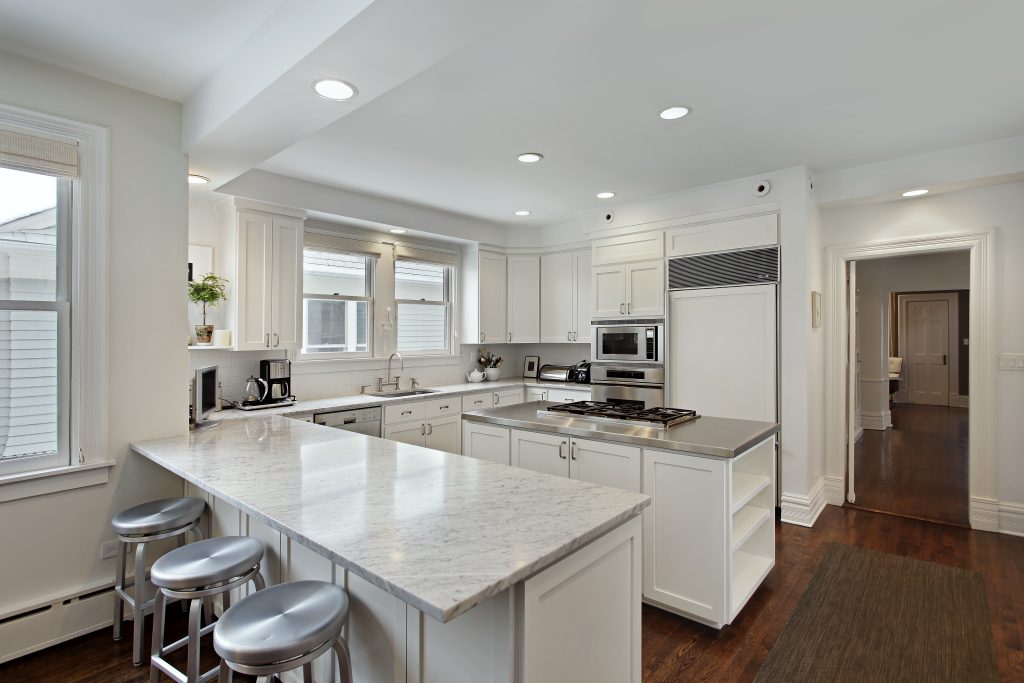
Should I bring a cabinet door or color sample?
Yes, a cabinet door sample is one of the most useful things you can bring. The countertop and cabinets usually occupy two of the largest visual areas in a kitchen, so seeing their actual colors together is much more reliable than trying to remember a cabinet shade from a photograph.
This matters particularly with white, gray, beige, and wood cabinetry. Two materials may both appear “white” on their own but have completely different undertones when placed beside one another.
For example, a quartz with cool gray veining may look excellent beside crisp white cabinets but slightly blue next to warm cream cabinetry. A warmer stone can work better with oak, walnut, or beige-toned cabinets.
If the cabinet sample is too large to transport, a high-quality photograph can still help. However, we prefer the actual door or finish sample whenever possible.
What photos should I bring?
Bring several photos showing the kitchen from different angles, preferably taken during the day. Photos help us understand the relationship between the countertop, cabinets, backsplash, appliances, walls, and flooring.
We recommend bringing:
- A wide photo of the entire kitchen
- A photo facing the main countertop
- A close-up of the cabinet finish
- A photo showing the backsplash
- A photo of the flooring
- Pictures of any island or peninsula
- A photo showing nearby wall colors
Lighting is especially important. A countertop that looks soft and warm in a showroom can appear cooler in a kitchen with LED lighting, while natural sunlight can bring out completely different tones in natural stone.
When customers are comparing countertops in Red Hill, SC, these photographs give us much more useful information than a simple description such as “my kitchen has gray cabinets.”
Do I need exact measurements before visiting?
No, you do not necessarily need professional measurements just to begin selecting material. We can discuss the approximate project size during the showroom stage, but final fabrication measurements need to be verified through the proper templating process.
If you already have architectural drawings or measurements from a contractor, bring them. They can help us understand the approximate countertop area and identify unusual sections.
We do not recommend ordering stone based solely on homeowner measurements. Sink openings, walls that are slightly out of square, cabinet depth, seams, overhangs, and appliance clearances can all affect fabrication.
The showroom visit is primarily about making the right material and design decisions. Precise fabrication comes later.
Should I bring my backsplash sample?
Yes, especially if the backsplash is staying. The relationship between countertop and backsplash can completely change how a stone looks.
A countertop with dramatic movement may look fantastic against a simple backsplash but become visually overwhelming beside a heavily patterned tile. Conversely, a very calm countertop can give a decorative backsplash room to stand out.
If the backsplash has already been installed, bring a tile sample if you have one. If you do not, bring clear photos taken in natural light.
At Granite Depot of Myrtle Beach, we often use this comparison to eliminate options quickly. A stone can be beautiful by itself and still be the wrong choice for a particular kitchen.
What if I am replacing the countertop but keeping everything else?
Bring as much of the existing kitchen into the decision as possible. When cabinets, flooring, backsplash, and appliances are staying, the new countertop has to work with those elements rather than being selected as though the room were completely new.
This is one of the most common situations we see. A homeowner may want a dramatic white quartzite or marble because they like the appearance online, but the existing kitchen may already have several competing patterns.
In those cases, we may recommend a quieter stone with subtle movement. The goal is not to choose the most impressive slab in the showroom. It is to choose the slab that makes the finished kitchen look intentional.
Should I bring flooring samples?
Yes, if the flooring is being kept. Flooring can have a surprisingly strong influence on countertop selection, particularly when the floor has noticeable brown, gray, beige, or reddish undertones.
Wood-look flooring is a good example. A countertop that works with cool gray flooring may clash with warm oak-look flooring even when both appear neutral in isolation.
We do not need a huge piece of flooring. A manufacturer sample, spare tile, or clear photograph can be enough to identify the dominant undertones.
Does the type of countertop change what I should bring?
The basic samples are useful for every material, but natural stone benefits from additional discussion about pattern and slab variation. Granite, marble, and quartzite can have substantial visual movement that is difficult to understand from a small sample.
Quartz tends to offer more predictable patterning, although some designs intentionally imitate the irregular movement of natural stone. That makes it important to look at the actual product rather than assuming every sample represents the entire slab.
Here is a simple comparison:
| Material | Pattern consistency | What to pay attention to |
|---|---|---|
| Granite | Natural variation | Mineral movement and color shifts |
| Quartz | Generally more consistent | Veining direction and repetition |
| Marble | Natural variation | Veining, etching expectations |
| Quartzite | Natural variation | Large-scale movement and color |
For homeowners comparing countertops in Red Hill, SC, we recommend asking whether the material being viewed is representative of the actual slab available for the project.

How much countertop do I actually need?
The amount depends on the kitchen layout, not simply the room’s square footage. Perimeter countertops, islands, peninsulas, appliance sections, and other surfaces all contribute to the total material requirement.
This also affects slab selection. A small kitchen may fit comfortably on one slab, while a larger kitchen or one with a substantial island may require more than one.
Seams are another consideration. We plan seam locations around the layout, sink openings, corners, and the characteristics of the material. With strongly veined stone, seam placement can be especially important because we want the pattern to transition as naturally as practical.
What price information should I bring or ask about?
Ask whether the quoted material price includes fabrication and installation or refers only to the stone itself. Comparing two prices without knowing what is included can make one countertop appear artificially cheaper.
Our current reference pricing is:
| Material | Reference price per sq. ft. |
|---|---|
| Granite | $42 |
| Quartz | $55 |
| Marble | $55 |
| Quartzite | $75 |
These figures provide a useful starting point, but the final project price can change depending on countertop size, edge profile, sink cutouts, seams, installation requirements, and other fabrication details.
At Granite Depot of Myrtle Beach, we encourage customers to ask about the complete scope rather than focusing only on the material number.
What should I ask about fabrication?
Ask how the stone will be cut, where seams are likely to be located, which edge profile is appropriate, and how sink and faucet openings will be handled. These details are easy to overlook when the main focus is choosing a color.
A typical fabrication process includes:
- Final material selection
- Confirmation of cabinet readiness
- Professional templating
- Layout and seam planning
- Sink and faucet cutouts
- Edge fabrication
- Stone fabrication
- Final installation
A 7–10 day fabrication period is a useful planning reference once measurements and material selections are finalized. Installation follows the fabrication stage and depends on the project’s scope and readiness.
Should I bring appliance information?
Yes, appliance dimensions can be helpful, especially for refrigerators, ranges, cooktops, and undermount sinks. Changes in appliance dimensions can affect countertop clearances and the way the stone is fabricated.
If you are installing a new sink, bring the model number or manufacturer’s specifications if available. Different sinks can require different cutout dimensions and installation methods.
This is one reason we prefer having project information early. It is much easier to solve a potential clearance problem before fabrication than after the stone has been cut.
What if I do not know what style I want yet?
That is completely fine. You do not need to arrive with a specific color or material already chosen.
Instead, tell us what you dislike. “I don’t want anything too busy,” “I hate yellow undertones,” “I want the countertop to be the focal point,” or “I don’t want to see fingerprints” are all useful starting points.
Those preferences help narrow the field. We can then compare calmer quartz, natural granite, marble, or quartzite options based on the actual room rather than starting with an enormous selection and hoping something feels right.
How do I compare several slabs without getting overwhelmed?
Start by eliminating materials that clearly conflict with the existing kitchen, then compare only a few finalists side by side. Looking at ten or twenty stones at once can make the differences harder to judge rather than easier.
We recommend evaluating each finalist using four questions:
- Does the undertone work with the cabinets?
- Does the pattern compete with the backsplash?
- Does the finish suit the way the kitchen is used?
- Does the material fit the maintenance expectations and budget?
Once those questions are answered, the decision usually becomes much clearer.
For homeowners researching countertops in Red Hill, SC, this approach is particularly useful because it shifts the conversation from “Which slab is prettiest?” to “Which slab makes sense in this kitchen?”
Does the showroom lighting matter?
Yes, showroom lighting can change how a countertop appears. Natural stone has depth and variation, and artificial lighting can emphasize some tones while muting others.
If possible, we recommend viewing samples near different lighting conditions. You can also take photographs of your finalists and compare them with photos of your kitchen.
Do not rely exclusively on your phone camera, though. Cameras automatically adjust exposure and white balance, so a photograph is useful for comparison but is not a perfect representation of the material.
What should I bring if I am ready to make a final decision?
Bring your cabinet sample, backsplash sample, flooring sample if available, kitchen photos, approximate measurements or plans, sink information, and appliance specifications. Also bring a realistic budget range and an idea of how quickly you need the project completed.
Having these details allows us to discuss the countertop as a complete project rather than simply a piece of stone.
At Granite Depot of Myrtle Beach, we also look at fabrication requirements, installation conditions, seams, edges, and cutouts before treating a material choice as final.
What is the best showroom checklist?
The best showroom visit starts with a small amount of preparation, not a truckload of samples. If we can see the existing kitchen and understand how the space is used, we can make much more useful recommendations.
Bring these if you have them:
- Cabinet door or finish sample
- Backsplash tile sample
- Flooring sample
- Kitchen photographs
- Kitchen plans or approximate measurements
- Sink model and dimensions
- Appliance specifications
- Budget range
- Inspiration photos
You do not need every item. Even three or four of these can make the selection process significantly easier.

FAQ
Do I need to know which countertop material I want before visiting?
No. We can compare granite, quartz, marble, and quartzite based on your kitchen, maintenance preferences, appearance, and budget.
Should I bring cabinet samples?
Yes. A cabinet door or finish sample is one of the most useful items for comparing countertop undertones.
Can I choose a countertop from a small sample?
You can begin with a sample, but we recommend reviewing the actual slab when possible, particularly for natural stones with significant movement.
How much does granite cost?
The current reference price is $42 per square foot. Fabrication, installation, cutouts, edges, and other project details may affect the final cost.
How long does countertop fabrication take?
A typical fabrication timeline is approximately 7–10 days after templating and final specifications are confirmed.
Is quartz easier to coordinate with existing cabinets?
Often, yes. Quartz typically provides more predictable color and pattern consistency, which can make coordination easier.
Should I bring my sink information?
Yes, especially if you are installing a new sink. The model and specifications help determine the required countertop cutout.
Can a countertop be selected before final measurements?
Yes. Material selection can happen before templating, but final fabrication should be based on verified measurements rather than homeowner estimates.
Choosing Countertops With the Whole Kitchen in Mind
At Granite Depot of Myrtle Beach, we serve homeowners in Myrtle Beach, SC and nearby communities, including Red Hill, with granite, quartz, marble, quartzite, countertop fabrication, and installation. Bringing a few useful samples and photos to the showroom helps us focus on the details that actually matter once the countertop is installed.
The best showroom visit is not necessarily the one where you see the most slabs. It is the one where you leave knowing why a particular stone works with your cabinets, lighting, backsplash, layout, and everyday life.