

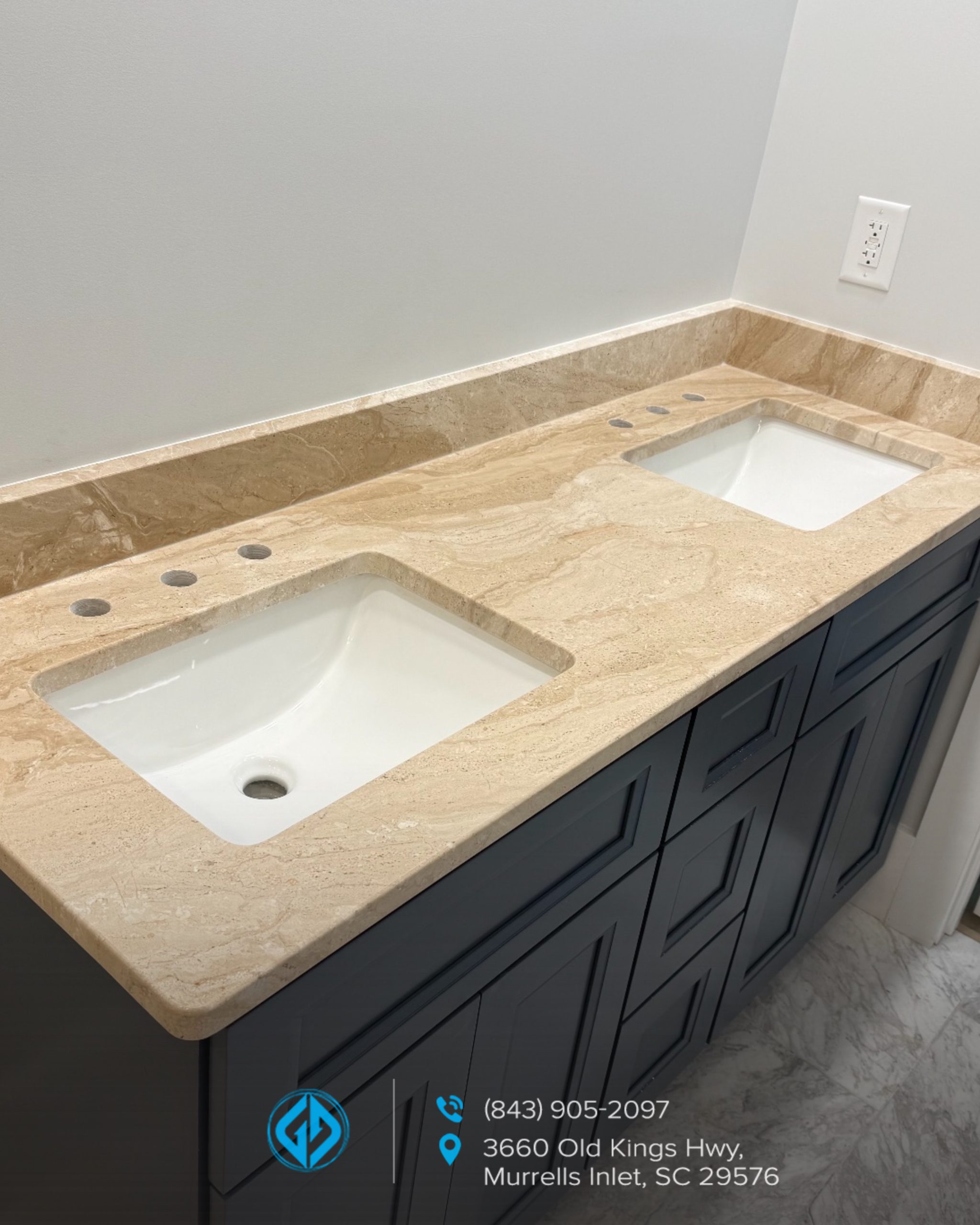
Some quartz countertops look almost identical to natural stone, while others have a noticeably manufactured appearance. The difference usually comes from the quality of the pattern, veining, color variation, slab design, and how realistically those elements are distributed across the surface.
When homeowners compare countertop installers in Forestbrook, SC, they often focus on the color first. We recommend looking much more closely at the pattern because two quartz slabs can have similar colors while looking completely different once installed.
At Granite Depot of Myrtle Beach, we help homeowners compare slabs in person because photographs rarely show the full pattern accurately. A countertop can look subtle in one small sample but much more dramatic across a full slab.
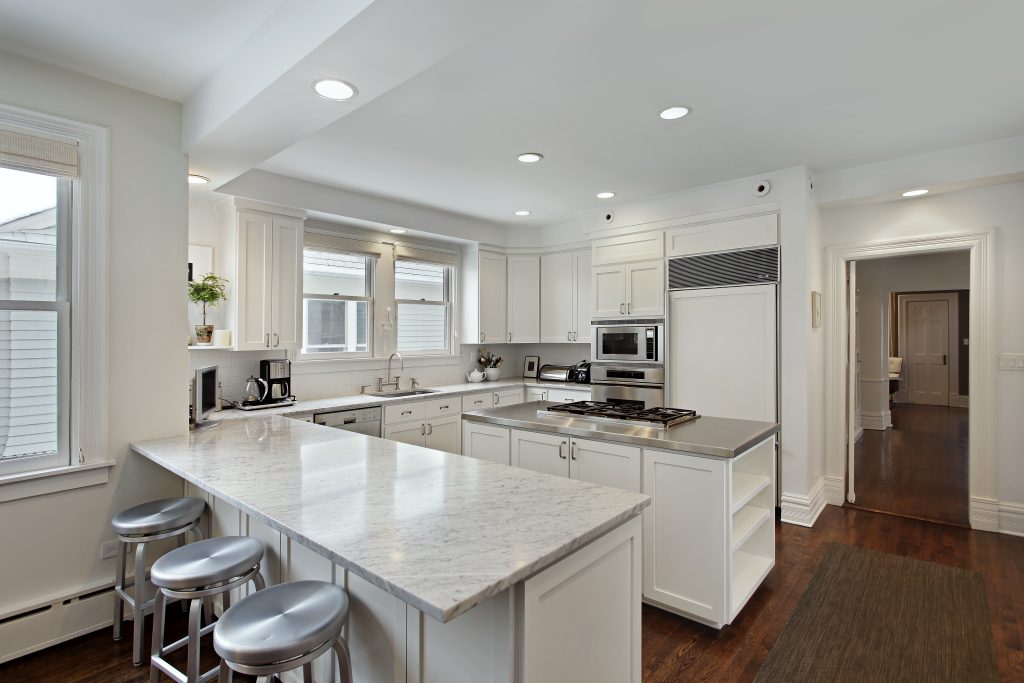
What makes quartz look more natural?
Natural-looking quartz usually has irregular veining, controlled color variation, and a pattern that does not repeat obviously. The goal is not necessarily to make quartz look exactly like granite or marble, but to reproduce the visual variation found in natural stone.
Natural stone develops its appearance through geological processes, so its veins and mineral patterns are rarely perfectly uniform. Quartz manufacturers use engineered pigments, aggregates, and printing technologies to create similar visual movement.
The most convincing designs usually avoid perfectly repeated veins or identical shapes. Instead, the pattern changes gradually across the slab, giving the surface more visual depth.
This matters particularly in large kitchens. A small sample may look realistic, but a repeated pattern can become much more noticeable when several slabs are installed next to one another.
Why does veining make some quartz look more realistic?
Veining is one of the biggest factors affecting how natural quartz appears. Realistic quartz often uses veins that vary in thickness, direction, intensity, and spacing instead of repeating the same line throughout the slab.
For example, marble-inspired quartz may contain soft gray veins running through a white background. More sophisticated designs can include several shades of gray, subtle translucent effects, and changes in vein intensity.
When we show slabs to homeowners, we recommend viewing the entire surface rather than judging a small sample. The relationship between the background color and the veins becomes much easier to evaluate at full size.
For homeowners comparing countertop installers in Forestbrook, SC, this is one of the most useful questions to ask: “Does the pattern repeat noticeably across the slab?”
Does the thickness of the quartz affect how natural it looks?
Thickness does not directly determine whether quartz looks natural, but the edge treatment can significantly affect the finished appearance. A well-designed edge can make the countertop look more substantial and allow the surface pattern to remain visually consistent.
Most residential quartz countertops use a standard thickness, while some projects use laminated edges to create a thicker visual profile. The fabrication method matters because the edge should coordinate with the pattern rather than look like a separate piece.
For a heavily veined quartz, edge fabrication requires additional attention. The fabricator may need to determine how the pattern should continue around the edge, especially when the countertop has waterfall ends or other exposed surfaces.
Why do some quartz slabs have more realistic color variation?
Realistic color variation comes from multiple tones working together rather than one perfectly uniform background. Natural-looking quartz may combine white, cream, gray, beige, taupe, or other subtle shades to create depth.
A completely uniform surface can look very clean, but it may also appear more manufactured. On the other hand, excessive variation can make a countertop look visually busy.
We usually recommend matching the amount of movement to the rest of the kitchen. If the cabinets and backsplash already contain strong patterns, a quieter quartz may be the better choice.
If the cabinets are simple, a more dramatic marble-look quartz can become the primary visual feature.
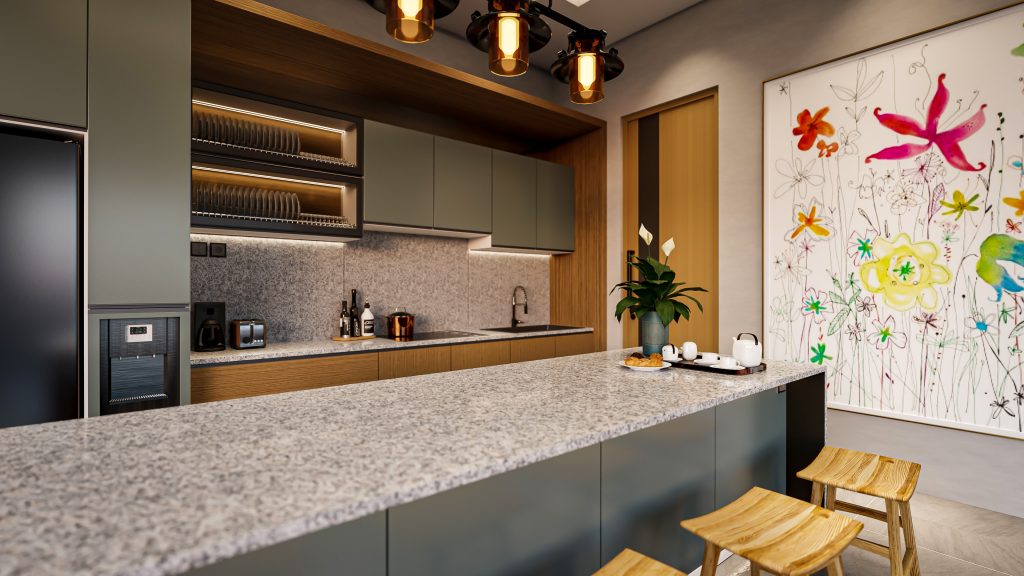
How does quartz compare with granite and marble?
Quartz, granite, and marble can all create attractive countertops, but their visual characteristics are different. Quartz is engineered for controlled consistency, while granite and marble naturally develop their patterns through geological processes.
| Material | Typical Price | Pattern | Maintenance | Natural Variation |
|---|---|---|---|---|
| Granite | $42/sq. ft. | Mineral-based | Moderate | High |
| Quartz | $55/sq. ft. | Engineered | Low | Controlled |
| Marble | $55/sq. ft. | Veined | Higher | High |
| Quartzite | $75/sq. ft. | Natural | Moderate | High |
These are the material price points we use as reference pricing; the final project cost can vary depending on fabrication, edge details, installation, sink cutouts, and other requirements.
Granite provides naturally occurring variation, so every slab has its own mineral structure. Marble is particularly known for flowing veins, while quartz can reproduce marble-like patterns with much more predictable coloration.
Is expensive quartz always more natural-looking?
No, higher price does not automatically mean a quartz slab will look more natural. Price can reflect the manufacturing process, brand, design complexity, availability, slab size, and other factors in addition to visual realism.
Some mid-range quartz can have a very convincing appearance, while an expensive design may still look repetitive if the pattern is too uniform.
We recommend evaluating the actual slab instead of choosing based solely on price. Look at the veining, background, slab-to-slab variation, and how the pattern will interact with your cabinet layout.
What should you look for when choosing natural-looking quartz?
The best approach is to inspect several characteristics at the same time. A realistic slab should have enough variation to create depth without making the pattern appear chaotic.
Look for:
- Irregular rather than repetitive veining
- Multiple subtle background tones
- Veins that vary in width
- Natural-looking transitions between colors
- Minimal obvious pattern repetition
- A pattern appropriate for the size of your kitchen
- Veining that works with your cabinet color
We also recommend checking the actual slab whenever possible. A small showroom sample cannot always show how the pattern will look across a full island or long countertop run.
Does fabrication affect how natural quartz looks?
Yes, fabrication can have a major effect on the finished appearance. Even a realistic quartz slab can look less natural if seams, cutouts, edges, or pattern transitions are poorly planned.
Seam placement is particularly important with strongly veined quartz. A seam running directly through a prominent vein may make the pattern appear interrupted, while careful slab planning can create a more visually continuous result.
At Granite Depot of Myrtle Beach, we consider the countertop layout before fabrication so we can account for sinks, cooktops, corners, seams, and other cutouts.
This is one reason experienced countertop installers in Forestbrook, SC can make a difference beyond simply placing the finished countertop on the cabinets.
How long does quartz countertop fabrication take?
A typical countertop project can often be completed within 7-10 days after the necessary measurements and template are completed, although the exact schedule depends on the material, fabrication requirements, installation details, and project complexity.
The process generally includes:
- Selecting the quartz slab.
- Confirming cabinet installation and dimensions.
- Completing the countertop template.
- Planning seams and cutouts.
- Fabricating the slabs.
- Finishing the edges.
- Delivering the countertops.
- Installing and securing the finished surfaces.
Accurate cabinet installation is important because countertop fabrication depends on the actual conditions at the job site.
How should quartz be matched with kitchen cabinets?
Quartz should complement the cabinets rather than compete with them. We generally look at cabinet color, wood grain, hardware, backsplash, flooring, and natural light before recommending a countertop pattern.
For white cabinets, gray-veined quartz is a common choice because it creates contrast without making the room feel dark. Warm beige or taupe veining can work particularly well with cream, natural wood, or warmer cabinet finishes.
Dark cabinets can support both light quartz with subtle veining and more dramatic surfaces. The right choice depends on whether the homeowner wants the countertop to blend in or become a focal point.
For homeowners researching countertop installers in Forestbrook, SC, we recommend bringing cabinet samples, backsplash samples, or photographs when comparing slabs.

Is quartz easier to maintain than natural stone?
Quartz generally requires less routine maintenance than many natural stones because it does not require the same type of periodic sealing used for porous materials such as some granite and marble. However, quartz still needs appropriate cleaning and should be protected from excessive heat and harsh chemicals.
| Feature | Quartz | Granite | Marble |
|---|---|---|---|
| Daily cleaning | Easy | Easy | Moderate |
| Routine sealing | Generally not required | May be required | Often recommended |
| Stain resistance | High | High when properly sealed | More sensitive |
| Scratch resistance | High | High | More susceptible |
| Heat resistance | Good, but avoid extreme heat | Very good | Very good |
| Pattern consistency | Controlled | Natural | Natural |
Quartz is therefore often attractive to homeowners who want a natural-stone appearance without the same level of maintenance associated with some natural materials.
Is natural-looking quartz worth choosing?
Yes, especially when homeowners want the visual character of natural stone with more predictable color and easier everyday maintenance. The key is choosing a slab whose pattern looks convincing at the scale of the actual kitchen.
We encourage homeowners to look beyond the sample color. Examine the full slab, study the direction of the veins, consider where seams will be placed, and compare the surface with your cabinets and backsplash.
A quartz countertop should look intentional once it is installed. The best result comes from treating the slab pattern as part of the kitchen design rather than as an isolated material choice.
FAQ: Natural-Looking Quartz Countertops
Why does some quartz look fake?
Highly repetitive veining, uniform coloration, and predictable patterns can make quartz appear more manufactured. More varied patterns generally create a more natural appearance.
Does expensive quartz always look more realistic?
No. Price reflects several factors, including manufacturing, brand, availability, and design complexity. A moderately priced slab can sometimes look more natural than a higher-priced option.
Is quartz more consistent than granite?
Yes. Quartz is manufactured under controlled conditions, while granite has naturally occurring mineral variation from slab to slab.
Can quartz look like marble?
Yes. Many quartz designs are specifically manufactured to reproduce the colors and flowing veins associated with marble.
Does quartz need to be sealed?
Most quartz countertops do not require routine sealing. The exact care requirements depend on the manufacturer’s recommendations.
How long does quartz countertop installation take?
Many projects can be completed within approximately 7-10 days after templating, although the exact schedule depends on fabrication and installation requirements.
What is the best way to choose realistic quartz?
View the largest available slab, examine the pattern for repetition, and compare it with your cabinets, backsplash, flooring, and lighting before making a final decision.
Quartz Countertops in Myrtle Beach, SC
Granite Depot of Myrtle Beach serves homeowners in Myrtle Beach, SC and surrounding communities, including Forestbrook, with countertop selection, fabrication, and installation. We work with granite, quartz, marble, quartzite, and other countertop materials and coordinate fabrication details such as edges, seams, sinks, and cooktop cutouts.
For homeowners comparing countertop installers in Forestbrook, SC, we focus on the entire project – from selecting the right slab to accurate templating, fabrication, and installation. The goal is not simply to choose attractive quartz, but to make sure the finished countertop looks right in the actual kitchen and functions properly for everyday use.