

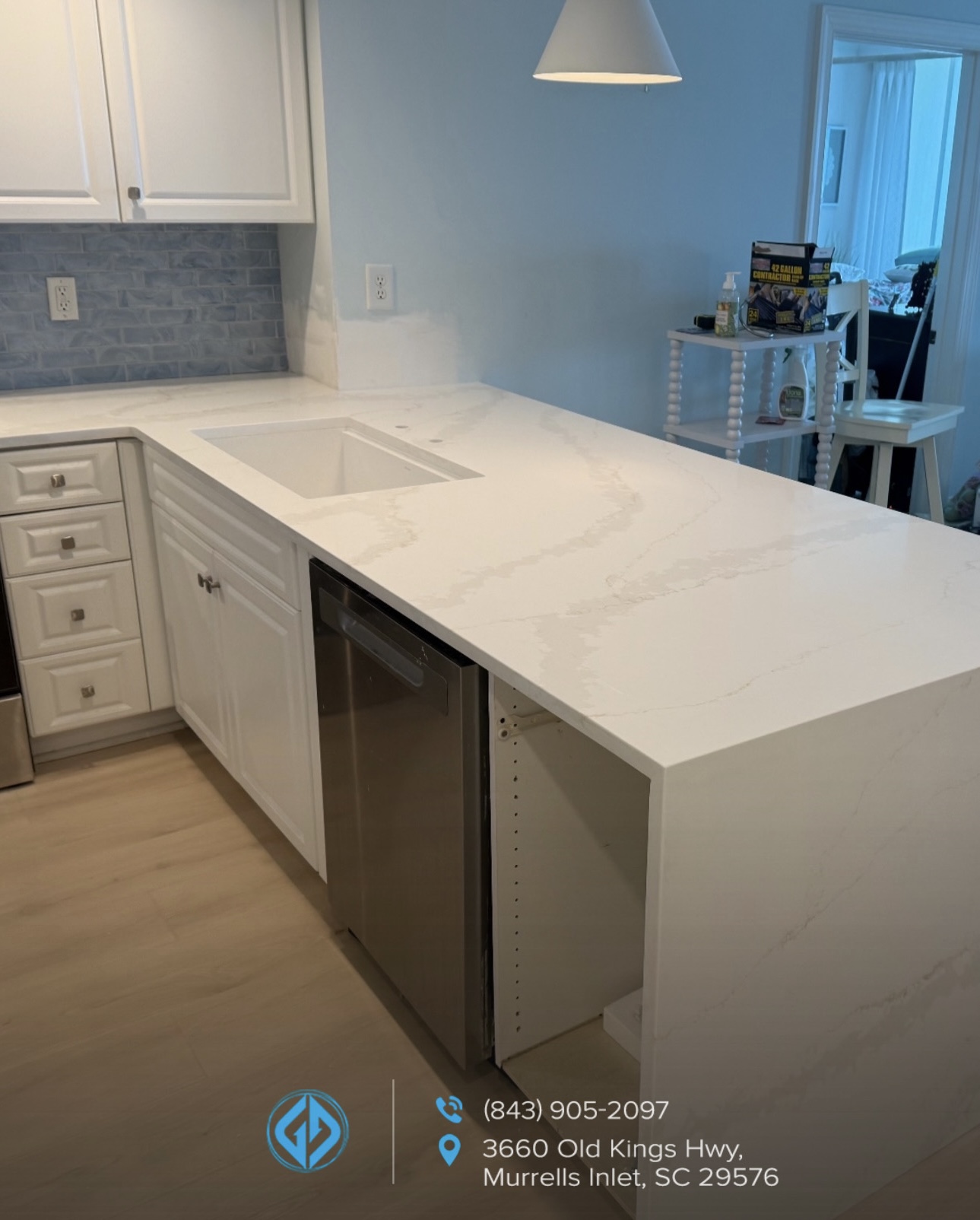
Most kitchen countertops should be 3 cm thick. This thickness works well for granite, quartz, marble, and quartzite because it looks finished and supports daily use.
At Granite Depot of Myrtle Beach, we choose thickness after checking the cabinets, island size, overhangs, sink style, edge profile, and backsplash plan. For homeowners comparing quartz countertops in Pamplico, SC, thickness affects more than appearance. It changes the way the countertop is fabricated, installed, and supported.
What is the standard countertop thickness?
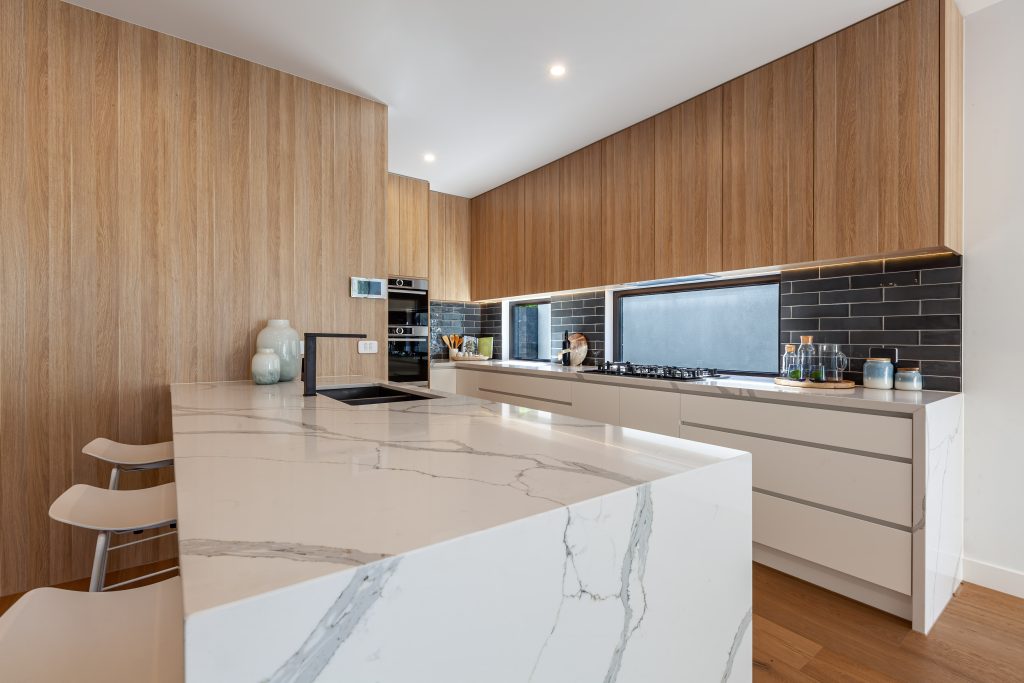
The standard kitchen countertop thickness is 3 cm, or about 1 1/4 inches. It is the most common choice for modern kitchens because it gives the surface a strong edge without making the design feel bulky.
A 2 cm slab, about 3/4 inch thick, can work in bathrooms, wall applications, or certain sleek kitchen designs. In kitchens, it may need extra support or a built-up edge. For quartz countertops in Pamplico, SC, 3 cm is usually the safer everyday choice because it balances strength, style, and installation efficiency.
| Thickness | Approximate Size | Common Use | Main Note |
|---|---|---|---|
| 2 cm | About 3/4 inch | Vanities, walls, select kitchens | May need added support |
| 3 cm | About 1 1/4 inches | Most kitchens | Strong and finished-looking |
| Built-up edge | Visually thicker | Islands and statement designs | Adds fabrication labor |
Is a thicker countertop always better?
No, a thicker countertop is not always better. A thicker look can add presence, but the best choice depends on cabinet strength, kitchen size, edge style, and material.
A compact kitchen can feel weighed down by an oversized edge. A large island may need more visual weight so it does not look thin. The goal is proportion, not thickness for its own sake.
Does countertop material change the best thickness?
Yes, the material changes how thickness should be planned. Granite, quartz, marble, and quartzite all have different weight, strength, movement, and maintenance needs.
Quartz is consistent and predictable, which makes 3 cm a practical kitchen option. Granite is strong and natural, marble is elegant but softer, and quartzite is dense and durable.
| Material | Common Kitchen Thickness | Daily Use Note | Planning Concern |
|---|---|---|---|
| Granite | 3 cm | Strong and heat-resistant | Needs sealing as needed |
| Quartz | 3 cm | Low maintenance | Protect from direct high heat |
| Marble | 2 cm or 3 cm | Elegant, softer look | Stains and etches more easily |
| Quartzite | 3 cm | Strong natural stone | Often higher in cost |
At Granite Depot of Myrtle Beach, we review the slab and the layout together before recommending thickness. The same 3 cm surface can feel very different on a small vanity, a long kitchen run, or a large island.
How does thickness affect the kitchen design?
Thickness affects how heavy, modern, traditional, or refined the kitchen feels. A 3 cm countertop looks complete in most kitchens, while a thinner surface feels lighter and more minimal.
Edge profile matters too. A simple eased edge keeps the look modern. A small roundover softens the feel. A mitered edge can make the countertop appear thicker, which is often used for islands.
For quartz countertops in Pamplico, SC, we often look at the cabinets first. Flat panel cabinets usually pair well with a clean edge. Shaker cabinets can handle a slightly softer edge.
| Design Goal | Good Thickness Choice | Why It Works |
|---|---|---|
| Clean modern kitchen | 3 cm with eased edge | Simple and balanced |
| Small kitchen | 3 cm, simple edge | Finished without bulk |
| Statement island | Mitered or built-up edge | Adds visual weight |
| Traditional kitchen | 3 cm with soft edge | Classic and practical |
How much does countertop thickness affect price?
Thickness can affect price through material quantity, fabrication labor, edge detail, support, and installation complexity. The edge profile and layout often change the price as much as the thickness itself.
Granite often starts around $42 per square foot, quartz around $55 per square foot, marble around $55 per square foot, and quartzite around $75 per square foot. Final pricing depends on square footage, slab choice, sink cutouts, cooktop cutouts, edge work, backsplash pieces, fabrication, and installation.
| Material | Starting Price | Practical Note |
|---|---|---|
| Granite | From about $42 per sq. ft. | Strong natural stone |
| Quartz | From about $55 per sq. ft. | Low-maintenance daily use |
| Marble | From about $55 per sq. ft. | Elegant but more delicate |
| Quartzite | From about $75 per sq. ft. | Premium natural stone |
Granite Depot of Myrtle Beach explains these details early because two kitchens with the same square footage can have different costs. For quartz countertops in Pamplico, SC, a simple 3 cm layout will usually price differently than a waterfall island, full-height backsplash, or mitered edge design.
What thickness is best for kitchen islands?
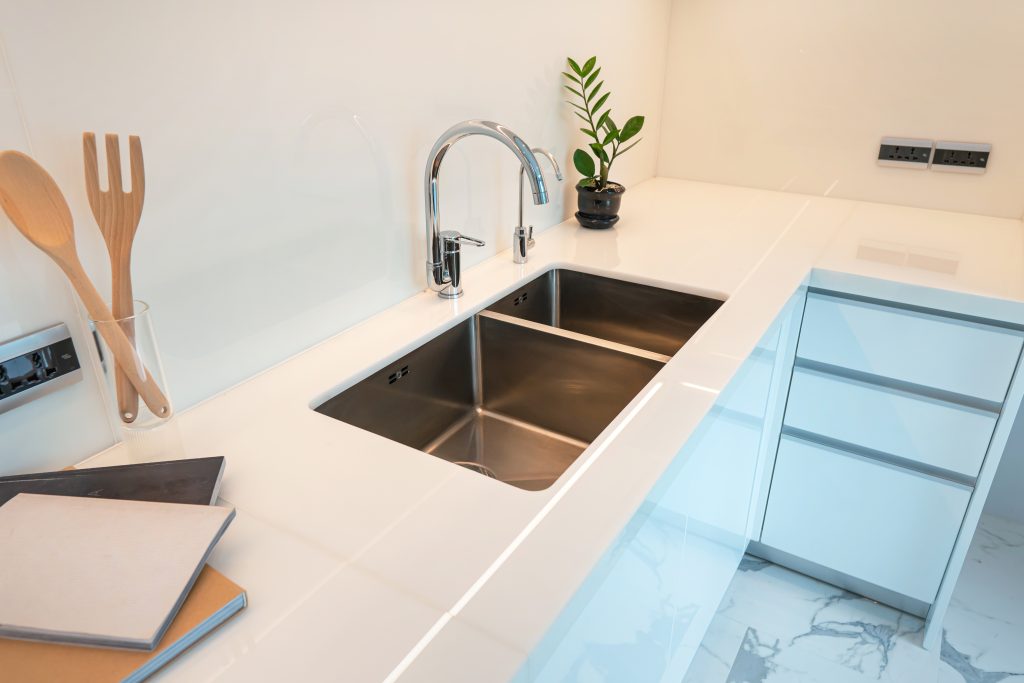
A 3 cm countertop is usually best for kitchen islands. Islands often need stronger visual weight and careful overhang support because they are used for food prep, seating, serving, homework, and casual meals.
If the island has seating, the overhang must be planned correctly. Depending on the size and material, support brackets or hidden support may be needed. Thickness does not replace proper structural planning.
A mitered edge can create a thicker luxury look without using one massive solid slab. It requires accurate fabrication because the edge pieces must align cleanly.
Do cabinets need extra support for thicker countertops?
Yes, cabinets must be level, stable, and properly installed before any stone countertop is templated. Heavy-looking or thicker countertop designs make cabinet support even more important.
Granite, quartz, marble, and quartzite are not flexible materials. If base cabinets are uneven, the countertop can have seam issues, stress points, or installation problems. Proper cabinet leveling also affects sink placement and overhangs.
How long does fabrication and installation take?
Most countertop projects take about 7 to 10 days after final measurements. Timing depends on material availability, thickness, edge detail, cutouts, fabrication schedule, and installation access.
The process usually starts with material selection and templating. Then the slab is cut, edged, polished, and prepared. Installation is often completed in one day for many kitchens.
| Step | What Happens | Typical Timing |
|---|---|---|
| Selection | Choose granite, quartz, marble, or quartzite | Same day or longer |
| Template | Final measurements are taken | 1 appointment |
| Fabrication | Stone is cut, edged, and polished | Several business days |
| Installation | Countertops are set and secured | Usually 1 day |
With Granite Depot of Myrtle Beach, we keep the timeline clear before work begins. Specialty thickness details, mitered edges, and complex islands can add more fabrication attention than a standard straight run.
What should be decided before final measurements?
Homeowners should choose the material, thickness, edge profile, sink type, faucet location, overhangs, and backsplash plan before final measurements. These choices affect fabrication.
Small decisions matter. A farmhouse sink changes support needs. A full-height backsplash changes wall planning. A large island overhang may need brackets. For quartz countertops in Pamplico, SC, finalizing these details early helps keep the 7 to 10 day process realistic.
FAQ: Kitchen countertop thickness
What is the most common kitchen countertop thickness?
The most common kitchen countertop thickness is 3 cm, or about 1 1/4 inches.
Is 2 cm too thin for a kitchen?
Not always, but 2 cm may need additional support or a built-up edge depending on the layout.
Is 3 cm quartz good for everyday use?
Yes. 3 cm quartz is a practical kitchen choice because it looks finished and performs well with proper support.
Does a thicker countertop cost more?
It can. Material, edge profile, cutouts, fabrication, and installation details all affect the final cost.
What thickness is best for an island?
A 3 cm countertop is usually best for islands. Larger statement islands may use a mitered or built-up edge.
How long does installation take?
Most projects take about 7 to 10 days after final measurements, depending on fabrication and scheduling.
What should I confirm before choosing quartz?
Confirm thickness, edge profile, sink type, cabinet support, backsplash plan, and installation timeline before fabrication.
Where can homeowners near Pamplico, SC get help choosing countertop thickness?
Granite Depot of Myrtle Beach is located in Myrtle Beach, SC and serves nearby communities, including Pamplico, SC. We help homeowners compare granite, quartz, marble, and quartzite, choose thickness, plan fabrication, and schedule installation. For homeowners considering quartz countertops in Pamplico, SC, our team can help match the material, edge, support, and design to the way the kitchen will be used every day.