

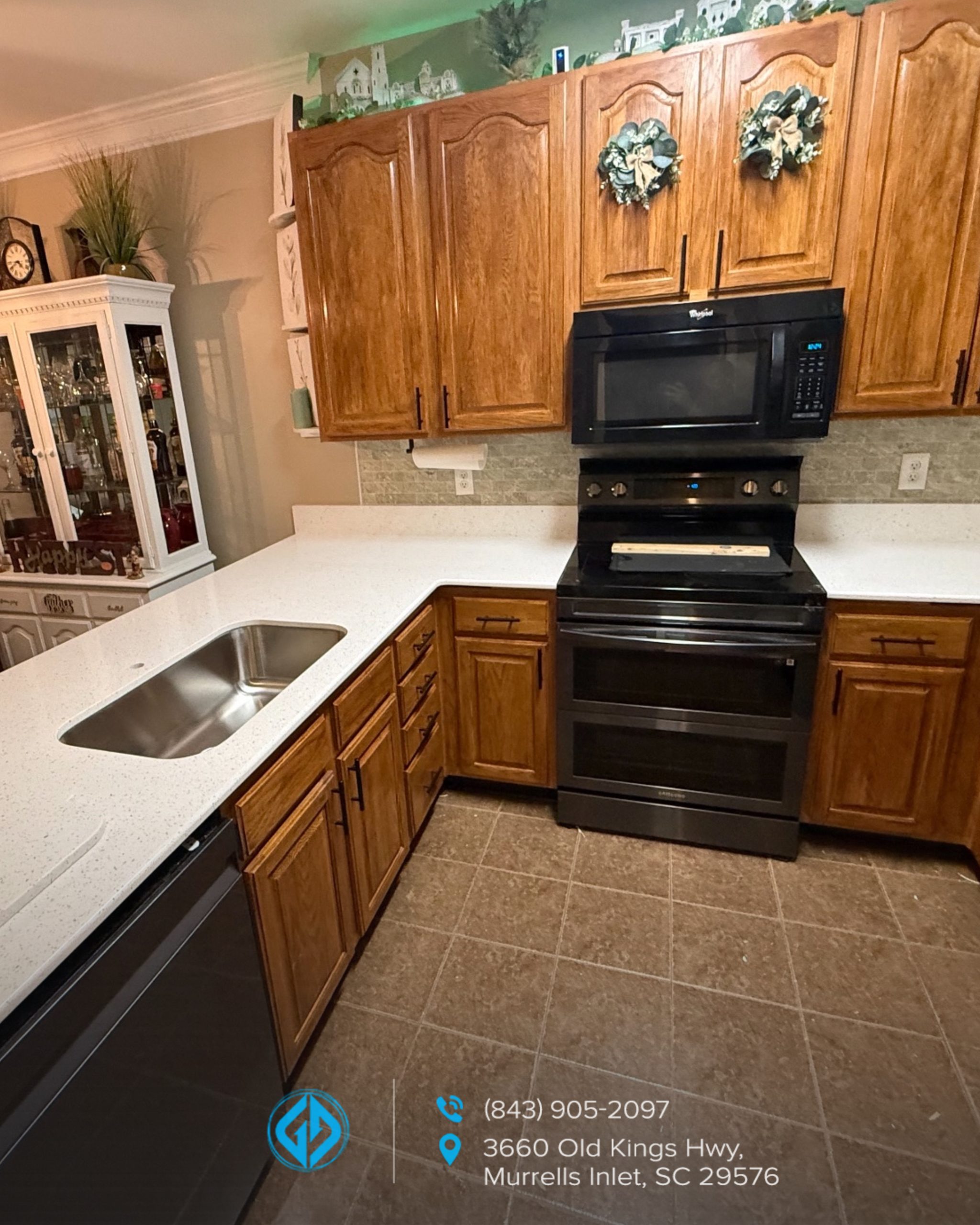
The best countertop material for pet owners is usually quartz when low maintenance, stain resistance, and everyday durability are the priorities. Granite is also a strong choice, especially for homeowners who prefer natural stone and do not mind periodic sealing.
Pets change how a kitchen gets used. Dogs may jump near the island, cats can climb onto counters, and muddy paws, food, water bowls, and treats can all create more opportunities for messes. When we help homeowners choose kitchen countertops in Forestbrook, SC, we look at how the surface will handle real household use rather than choosing a material based only on appearance.
At Granite Depot of Myrtle Beach, we regularly compare granite, quartz, marble, and quartzite based on maintenance, durability, staining, and the homeowner’s daily routine.

Is quartz the best countertop for homes with pets?
Quartz is often the most practical countertop choice for pet owners because it is nonporous and requires very little routine maintenance. Unlike natural stone, quartz does not need regular sealing to maintain its resistance to everyday spills and stains.
That matters in a busy kitchen. A pet’s water bowl can leave standing moisture, treats can create oily residue, and food can get dragged across the counter. Quartz gives homeowners a surface that is relatively easy to wipe clean without adding a sealing schedule.
Quartz is also available in a wide range of colors and patterns. Some designs imitate marble or natural stone closely, so homeowners do not necessarily have to choose between a low-maintenance surface and a natural-stone appearance.
How does granite perform with pets?
Granite is an excellent option for pet owners who want natural stone and strong resistance to everyday kitchen use. It is hard, durable, and available in many patterns that can make crumbs, minor marks, and everyday visual wear less noticeable.
The main difference is maintenance. Granite is a porous natural stone, so it should be properly sealed to help reduce staining and moisture absorption.
For households with pets, this is especially relevant around food preparation areas and water bowls. We recommend cleaning spills reasonably quickly and maintaining the stone according to its sealing requirements.
Is marble a good choice for pet owners?
Marble can work in a pet-friendly kitchen, but it requires more care than quartz or granite. Marble is relatively softer and more susceptible to scratching, etching, and staining from certain substances.
A pet owner who loves the appearance of marble should understand this tradeoff before choosing it. A kitchen with a dog that regularly jumps near the counters or a household that wants a completely worry-free surface may be better suited to quartz.
Marble can still make sense when appearance is the priority and the homeowner accepts that natural patina and surface changes are part of owning the material.
Is quartzite durable enough for a pet-friendly kitchen?
Yes, quartzite is a very durable natural stone and can be an excellent choice for active households. It combines a natural-stone appearance with strong resistance to everyday wear.
Quartzite is different from engineered quartz, despite the similar names. Quartzite is a natural stone that is quarried and fabricated, so it generally requires sealing and appropriate stone maintenance.
For homeowners who want natural stone but need a surface capable of handling frequent kitchen activity, quartzite can be a strong middle ground between appearance and durability.
Which countertop materials resist scratches best?
Granite and quartzite generally provide excellent scratch resistance, while quartz also performs well under normal kitchen use. Marble requires more caution because it is more susceptible to scratching and surface changes.
The countertop material is only part of the equation. A sharp object, heavy cookware, or abrasive cleaning product can damage almost any surface if used improperly.
Here is a practical comparison:
| Material | Scratch Resistance | Stain Resistance | Maintenance |
|---|---|---|---|
| Quartz | High | Excellent | Low |
| Granite | High | Very good when sealed | Moderate |
| Quartzite | Very high | Very good when sealed | Moderate |
| Marble | Moderate | Moderate | Higher |
For kitchen countertops in Forestbrook, SC, we usually recommend thinking about the homeowner’s habits first. If the goal is minimum maintenance, quartz has a clear advantage. If natural stone is important, granite or quartzite may be better fits.
Which countertop is easiest to clean after pets make a mess?
Quartz is generally the easiest countertop to clean because its nonporous surface does not absorb ordinary spills the way porous natural stone can. For everyday messes, a soft cloth and appropriate countertop cleaner are usually sufficient.
This can make a noticeable difference in a home with pets. Water from a bowl, wet food, oils from treats, or muddy paw residue can be wiped from the surface without worrying about the same type of absorption associated with some natural stones.
Granite is also easy to clean when properly sealed. We recommend avoiding harsh or abrasive products because aggressive cleaners can damage the finish or affect the sealer.
Does pet hair affect countertop maintenance?
Pet hair is easy to remove from smooth countertop surfaces, but darker colors and highly polished finishes can make individual hairs more visible. The issue is therefore more about appearance than the countertop material itself.
A patterned granite can disguise small amounts of hair, crumbs, and everyday debris better than a completely uniform dark surface. Quartz offers similar flexibility because it comes in many patterns and colors.
For busy households, we often suggest choosing a surface that does not visually highlight every crumb or piece of pet hair. The easiest countertop to live with is not necessarily the plainest one.
Can dogs scratch or damage kitchen countertops?
Dogs are unlikely to damage a properly installed granite or quartz countertop through normal contact, but sharp claws, heavy objects, and repeated impacts can still create problems. The bigger concern is usually what happens around the countertop rather than the pet simply walking across it.
For example, a large dog jumping against an island can put stress on nearby cabinetry or fixtures. A pet knocking a heavy bowl onto the edge of a countertop can also cause a chip, particularly at a vulnerable corner.
This is why proper fabrication and installation matter. At Granite Depot of Myrtle Beach, we consider edges, corners, sink cutouts, overhangs, and cabinet support when preparing a countertop for installation.
Which countertop material is best around pet food and water bowls?
Quartz is generally the easiest choice around pet food and water bowls because its nonporous surface resists absorption and is simple to wipe clean. Granite can also work very well when properly sealed.
Standing water is worth paying attention to with natural stone. A countertop does not necessarily need to be damaged immediately by a water bowl, but consistent moisture makes proper sealing and routine cleaning more important.
For pet owners, we also recommend placing bowls on a tray or mat when possible. This protects the surrounding countertop and cabinetry from constant moisture and makes cleanup easier.

How much do pet-friendly countertop materials cost?
Current material reference prices at Granite Depot of Myrtle Beach are $42 per square foot for granite, $55 for quartz, $55 for marble, and $75 for quartzite. The final installed price depends on fabrication, edge profiles, sink cutouts, removal, delivery, installation, and the complexity of the kitchen.
| Material | Material Price | Maintenance Level | Pet-Friendly Rating |
|---|---|---|---|
| Granite | $42/sq. ft. | Moderate | Excellent |
| Quartz | $55/sq. ft. | Low | Excellent |
| Marble | $55/sq. ft. | Higher | Good with care |
| Quartzite | $75/sq. ft. | Moderate | Excellent |
These figures are material prices rather than guaranteed installed project totals. A kitchen with multiple cutouts, unusual angles, or a large island will require additional fabrication work.
When comparing kitchen countertops in Forestbrook, SC, we recommend comparing the complete project rather than choosing solely by the price per square foot.
How long does it take to install a new countertop?
Most standard countertop projects can move from template to fabrication and installation within approximately 7-10 days, depending on material availability and project complexity. More complicated kitchens may require additional time.
The typical process includes:
- Measuring and templating the existing kitchen.
- Confirming material and edge selections.
- Fabricating the countertop.
- Preparing sink and appliance cutouts.
- Removing the existing countertop if necessary.
- Installing and securing the new surface.
- Completing the final inspection.
Proper installation is particularly important in a pet-friendly kitchen because the countertop may experience frequent daily use.
Should pet owners choose light or dark countertops?
Pet owners should choose a countertop color based on both lifestyle and the visibility of everyday messes. Medium tones and naturally patterned surfaces can be easier to live with because they tend to disguise crumbs, hair, water spots, and small marks.
Very dark polished surfaces can show dust and pet hair more clearly. Very light surfaces may make food residue and muddy marks more obvious.
The best choice is often a color with some natural variation rather than a completely uniform surface. Granite, quartz, and quartzite all offer patterns that can make routine kitchen cleanup feel less demanding.
What countertop is best for a busy family with pets?
Quartz is usually the best all-around choice when the priority is low maintenance, stain resistance, and easy cleaning. Granite and quartzite are excellent alternatives when the homeowner prefers natural stone.
Our practical ranking for most pet-owning households looks like this:
- Quartz: Best for low maintenance and easy cleanup
- Granite: Best for natural stone and everyday durability
- Quartzite: Best for natural stone with very high durability
- Marble: Best for homeowners who prioritize appearance and accept more maintenance
The right material ultimately depends on how the kitchen is used. A household with two dogs, young children, and frequent cooking may have very different priorities from a couple with one indoor cat.

FAQ: Countertops for Pet Owners
What is the most pet-friendly countertop material?
Quartz is generally the most practical because it is nonporous, easy to clean, and requires minimal maintenance.
Can dogs scratch quartz countertops?
Normal contact is unlikely to scratch a quality quartz countertop, but sharp objects and abrasive materials can still damage the surface.
Does granite need to be sealed if I have pets?
Yes. Proper sealing helps reduce staining and moisture absorption, which is particularly useful around pet food and water areas.
Is marble a bad choice for pet owners?
Not necessarily, but marble requires more care because it can scratch, stain, and etch more easily than quartz or granite.
Is quartzite good for a busy kitchen?
Yes. Quartzite is a highly durable natural stone and can be a strong choice for active kitchens when properly fabricated, sealed, and maintained.
What countertop hides pet hair best?
Medium-tone countertops with natural patterns generally hide pet hair and everyday debris better than completely uniform dark or very light surfaces.
How much does granite cost?
The current material reference price is $42 per square foot. Fabrication and installation costs vary according to the project.
Choosing Countertops in Myrtle Beach, SC
Granite Depot of Myrtle Beach works with homeowners in Myrtle Beach, SC and surrounding communities, including Forestbrook. We provide countertop selection, fabrication, installation, and related services for granite, quartz, marble, and quartzite.
For homeowners comparing kitchen countertops in Forestbrook, SC, we can help evaluate the material based on pets, cooking habits, cleaning expectations, appearance, and budget. The goal is to choose a countertop that fits the way the household actually lives, not simply the way the kitchen looks on installation day.